




THIS WORLD HUNGER DAY, WE LOOK AT THE RAPIDLY CHANGING LANDSCAPE OF GLOBAL HUNGER AND POVERTY.
World Hunger Day is an initiative by The Hunger Project.
Hunger is not just about food. Hunger and poverty are inextricably linked to a nexus of issues including: healthcare, decent work opportunities, education, social justice, the rights of women and girls, the environment and climate change.
The Hunger Project uses an innovative, holistic approach that tackles all these issues, and empowers people living in hunger to become the agents of their own development and lift their communities above the poverty line for good – this is the sustainable end of poverty.
This year, we’re using World Hunger Day to look at hunger as a whole.
Join us as we acknowledge and explore the increased risk of hunger and poverty in vulnerable communities – internationally and domestically – as, together, we confront the COVID-19 pandemic.
More than 820 million people in the world do not have enough food.
Join us on World Hunger Day to make a difference in the most vulnerable communities.

On February 26, 2015, The Hunger Project released the article below
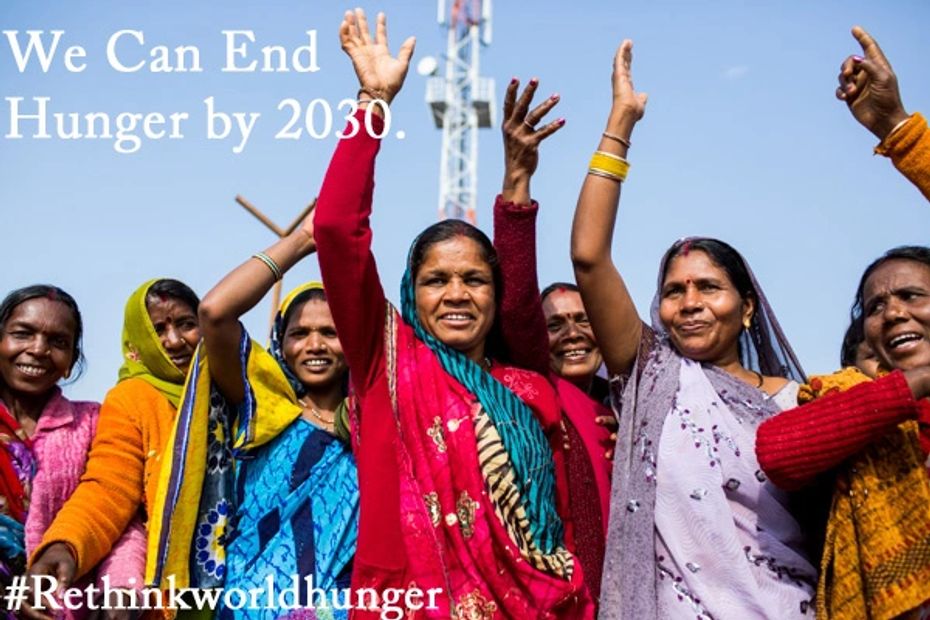
It’s time to rethink the solution to ending hunger. We know that hand-outs don’t work. We know that top-down models of aid don’t work. We do know that ending hunger is possible within our generation and that world hunger has been reduced dramatically in the last 30 years. So, what works? How can we end world hunger?
There are three critical elements that we know gets results: starting with women, mobilizing everyone and fostering effective partnerships with local government. Here’s why:
1. Starting with women
Empowering women and girls is critical to ending hunger, extreme poverty and malnutrition around the world. When women have equal access to education and participate fully in decision-making, they are the key driving force against hunger and poverty. Women with equal rights are better educated, healthier, and have greater access to land, jobs and financial resources. Their increased earning power in turn raises household incomes.
By enhancing women’s control over decision-making in the household, gender equality also translates into better prospects and greater well-being of children, reducing poverty of future generations. Indeed, if women farmers had the same access to resources as men, the number of hungry in the world could be reduced by up to 150 million. And, data shows, that countries that empower women tend to see lower rates of stunting (low height for age), the primary measure of chronic undernutrition.
2. Mobilizing Everyone
Mobilizing communities to be the agents of their own change is central to ending hunger. Hungry people are not the problem – they are the solution. People living in conditions of hunger and poverty are best placed to come up with answers to the challenges they face. They have both the talent and the will to take charge of their own lives. They know their own needs and are aware of the resources their communities have and those they lack.
That’s why mobilizing the “people power” that gives communities the clout and voice to demand the resources that are rightfully theirs ignites communities to end their own hunger.
We focus on training members of communities to take action in the areas of health, food security, education family income and local government, who, in turn, are mobilizing millions of others to do the same. Through our Epicenter Strategy in Africa, for example, more than 100 clusters of villages have launched village-level projects to generate their own income and build classrooms, food storage facilities and nurses’ quarters to ensure ready access to health care.
3. Foster effective partnerships with local government
Working with, not alongside of, government is central for long-term, sustainable development and ending hunger. Working with existing local democratic institutions to strengthen capacity and make the most of the resources that are already available makes for lasting change. Local government is closest to the people and has the mission of working with people to meet their basic needs. Working in partnership with local government bodies to ensure that they are effective, include the leadership of women, are directly accountable to local people, and provide access to resources and information are what gets results.
With these strategies, we can break through age-old conditions such as corruption, conflict, racism and the subjugation of women. The result is social transformation: a fundamental shift in the way society is organized. Thus, the solution to hunger is not about hand-outs and a top-down approach, but a bottom-up approach that starts with women, works with local government and mobilizes communities to take self-reliant actions.
The number of hungry people is reducing. But it’s still 805 million too many. We are at a critical point where we can harness the power of individuals, communities and local governments to end hunger.
Learn More:
Get involved with the Rethink World Hunger campaign.
Get connected with one of 22 local Hunger Project offices around world.
Give Now: Invest in the women and men who are working to end their own hunger and poverty.